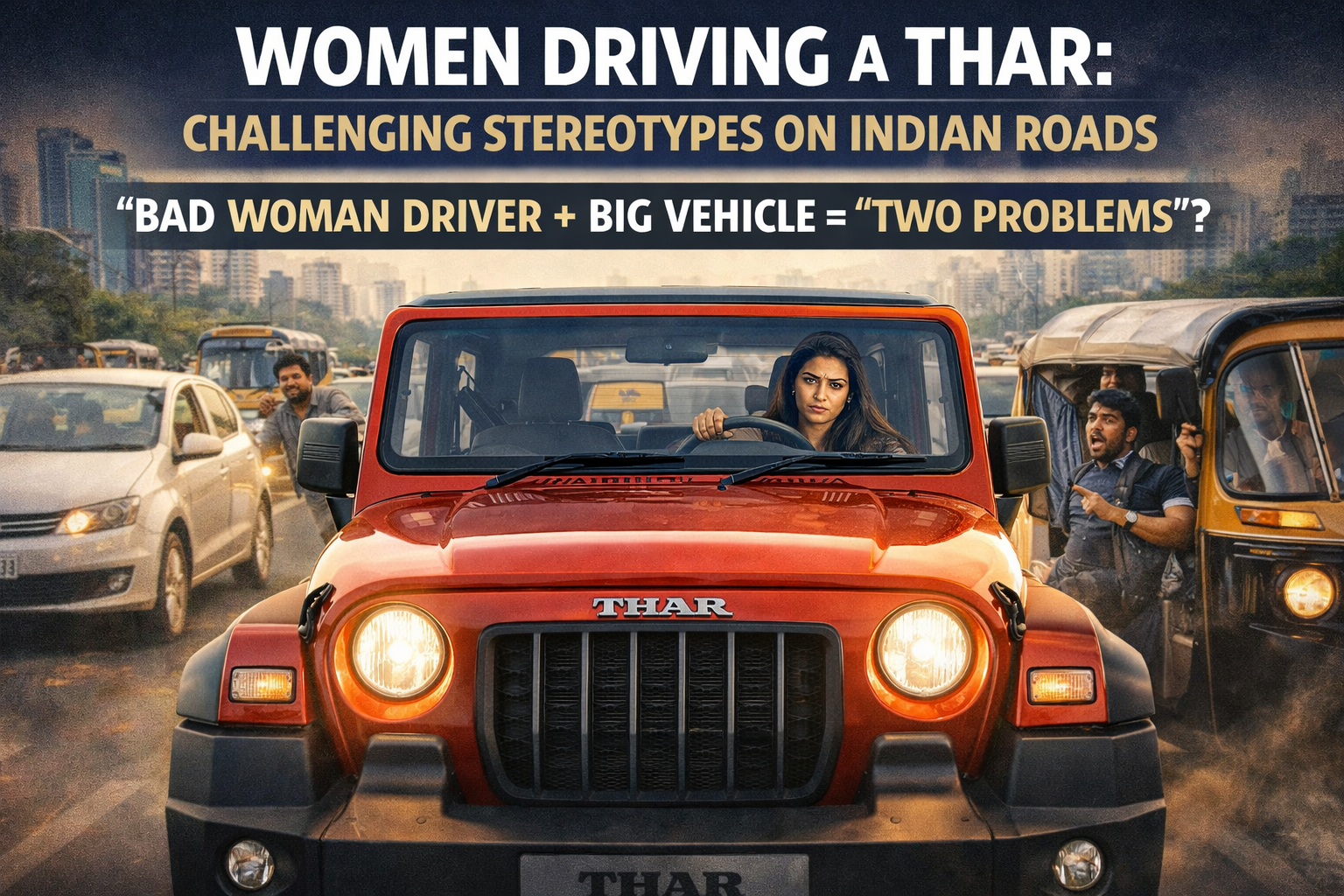
In India’s rapidly evolving urban landscape, more women are taking the driver’s seat—literally and figuratively. Yet, despite progress, deep-rooted stereotypes continue to shape perceptions. The phrase “bad driver” is often casually associated with women, reflecting a bias that persists across generations. When combined with driving a rugged vehicle like the Mahindra Thar, the judgment intensifies, turning a simple act of driving into a social statement.
This article explores the intersection of gender bias, societal expectations, and the lived experiences of women drivers navigating both roads and perceptions.
The Stereotype of the ‘Bad Woman Driver’
The stereotype that women are poor drivers is not unique to India, but it is particularly pronounced in societies where traditional gender roles are deeply ingrained. Despite evidence to the contrary, such assumptions continue to influence how women are perceived on the road.
These stereotypes are often reinforced through casual remarks, jokes, and even media portrayals. Over time, they shape public opinion, creating an environment where women drivers are judged more harshly than their male counterparts.
The reality, however, is far more complex. Driving skills are not determined by gender but by training, experience, and awareness.
Explanation:
This section explains the origin and persistence of the stereotype. It highlights how cultural narratives and social conditioning contribute to biased perceptions.
Driving a Thar: Challenging Traditional Norms
The Mahindra Thar is widely associated with power, adventure, and masculinity. It is often seen as a symbol of ruggedness, traditionally linked to male drivers.
When a woman drives a Thar, it challenges these norms, often leading to heightened scrutiny. Instead of being appreciated for breaking barriers, she may face skepticism or unsolicited opinions.
This reaction reflects a broader discomfort with changing gender roles, where women stepping into traditionally male-dominated spaces are met with resistance.
Explanation:
This section focuses on the symbolism of the Thar. It explains how driving such a vehicle amplifies societal reactions and challenges gender norms.
The Everyday Reality on Indian Roads
For many women, driving in India involves more than just navigating traffic. It includes dealing with stares, comments, and assumptions from other road users.
From unnecessary honking to being second-guessed at intersections, the experience can be mentally exhausting. These interactions often stem from preconceived notions rather than actual driving behavior.
Despite these challenges, women continue to assert their presence on the road, gradually reshaping perceptions through their actions.
Explanation:
This section describes real-world experiences. It highlights the challenges women face daily while driving and how bias manifests in subtle ways.
Bias Beyond the Road: Social Expectations
The challenges do not end when the engine is turned off. Women drivers often face questions from family, peers, and society about their choices.
Driving a large or powerful vehicle can invite comments about suitability, safety, and even femininity. These expectations reflect broader societal attitudes toward gender roles.
Such biases can discourage women from exploring opportunities or expressing their preferences freely.
Explanation:
This section discusses societal pressures beyond driving. It explains how gender expectations influence perceptions and decisions.
Changing Trends: More Women Behind the Wheel
Despite the challenges, there has been a noticeable increase in the number of women drivers in India. Urbanization, education, and economic independence have contributed to this shift.
Driving is increasingly seen as a symbol of freedom and self-reliance. Women are embracing this change, challenging stereotypes and redefining norms.
This trend is gradually altering public perception, although progress remains uneven across different regions and communities.
Explanation:
This section highlights positive changes. It explains how increasing participation is helping to challenge stereotypes.
The Role of Media and Representation
Media plays a significant role in shaping perceptions of women drivers. Positive representation can challenge stereotypes, while negative portrayals can reinforce them.
Films, advertisements, and social media content have the power to influence how society views women behind the wheel. Balanced and realistic portrayals are essential for changing narratives.
As more stories highlight capable and confident women drivers, societal attitudes are likely to evolve.
Explanation:
This section explains the influence of media. It highlights how representation can either reinforce or challenge stereotypes.
Breaking the Bias: The Importance of Awareness
Addressing gender bias requires collective effort. Awareness campaigns, education, and open conversations can help challenge misconceptions.
Encouraging respectful behavior on the road and promoting gender-neutral attitudes are key steps toward change. Institutions and communities can play a role in fostering inclusivity.
Breaking stereotypes is not just about proving them wrong but about creating an environment where they no longer exist.
Explanation:
This section focuses on solutions. It explains how awareness and education can help reduce bias.
Empowerment Through Driving
For many women, driving is more than a skill—it is a form of empowerment. It provides independence, confidence, and the ability to navigate life on their own terms.
Owning and driving a vehicle like the Thar can symbolize breaking barriers and challenging societal expectations. It reflects a shift toward greater autonomy and self-expression.
Such experiences contribute to broader social change, inspiring others to follow suit.
Explanation:
This section highlights the empowering aspect of driving. It explains how it contributes to personal and social transformation.
Conclusion: Redefining the Narrative
The idea that a woman driving a Thar represents “two problems” reveals more about societal bias than actual ability. It underscores the need to move beyond outdated stereotypes and embrace a more inclusive perspective.
As more women take the wheel, they are not just navigating roads—they are challenging perceptions and reshaping narratives. The journey toward equality may be gradual, but every step forward matters.
Ultimately, the road ahead is not just about better driving conditions but about creating a society where individuals are judged by their abilities, not their gender.
reclamatomplo.com reclamatomplo.com reclamatomplo.com reclamatomplo.com reclamatomplo.com reclamatomplo.com reclamatomplo.com reclamatomplo.com reclamatomplo.com reclamatomplo.com reclamatomplo.com reclamatomplo.com reclamatomplo.com reclamatomplo.com reclamatomplo.com reclamatomplo.com reclamatomplo.com reclamatomplo.com reclamatomplo.com reclamatomplo.com reclamatomplo.com reclamatomplo.com reclamatomplo.com reclamatomplo.com reclamatomplo.com reclamatomplo.com reclamatomplo.com reclamatomplo.com reclamatomplo.com reclamatomplo.com reclamatomplo.com reclamatomplo.com reclamatomplo.com reclamatomplo.com reclamatomplo.com reclamatomplo.com reclamatomplo.com reclamatomplo.com reclamatomplo.com reclamatomplo.com reclamatomplo.com reclamatomplo.com reclamatomplo.com reclamatomplo.com reclamatomplo.com reclamatomplo.com reclamatomplo.com reclamatomplo.com reclamatomplo.com reclamatomplo.com reclamatomplo.com reclamatomplo.com reclamatomplo.com reclamatomplo.com reclamatomplo.com reclamatomplo.com reclamatomplo.com reclamatomplo.com reclamatomplo.com reclamatomplo.com reclamatomplo.com reclamatomplo.com reclamatomplo.com reclamatomplo.com reclamatomplo.com reclamatomplo.com reclamatomplo.com reclamatomplo.com reclamatomplo.com reclamatomplo.com reclamatomplo.com reclamatomplo.com reclamatomplo.com reclamatomplo.com reclamatomplo.com reclamatomplo.com reclamatomplo.com reclamatomplo.com reclamatomplo.com reclamatomplo.com reclamatomplo.com reclamatomplo.com reclamatomplo.com reclamatomplo.com reclamatomplo.com reclamatomplo.com reclamatomplo.com reclamatomplo.com reclamatomplo.com reclamatomplo.com reclamatomplo.com reclamatomplo.com reclamatomplo.com reclamatomplo.com reclamatomplo.com reclamatomplo.com reclamatomplo.com reclamatomplo.com reclamatomplo.com reclamatomplo.com reclamatomplo.com reclamatomplo.com reclamatomplo.com reclamatomplo.com reclamatomplo.com reclamatomplo.com reclamatomplo.com reclamatomplo.com reclamatomplo.com reclamatomplo.com reclamatomplo.com reclamatomplo.com reclamatomplo.com reclamatomplo.com reclamatomplo.com reclamatomplo.com reclamatomplo.com reclamatomplo.com reclamatomplo.com reclamatomplo.com reclamatomplo.com reclamatomplo.com reclamatomplo.com reclamatomplo.com reclamatomplo.com reclamatomplo.com reclamatomplo.com reclamatomplo.com reclamatomplo.com reclamatomplo.com reclamatomplo.com reclamatomplo.com reclamatomplo.com reclamatomplo.com reclamatomplo.com reclamatomplo.com reclamatomplo.com reclamatomplo.com reclamatomplo.com reclamatomplo.com reclamatomplo.com reclamatomplo.com reclamatomplo.com reclamatomplo.com reclamatomplo.com reclamatomplo.com reclamatomplo.com reclamatomplo.com reclamatomplo.com reclamatomplo.com reclamatomplo.com reclamatomplo.com reclamatomplo.com reclamatomplo.com reclamatomplo.com reclamatomplo.com reclamatomplo.com reclamatomplo.com reclamatomplo.com reclamatomplo.com reclamatomplo.com reclamatomplo.com reclamatomplo.com reclamatomplo.com reclamatomplo.com reclamatomplo.com reclamatomplo.com