For many middle-class families in India, success has traditionally been defined by stability. A prestigious engineering degree, a secure job at a globally recognized company, and financial security have long been considered the ideal career path. Among technology professionals, landing a position at Google has often represented the pinnacle of professional achievement.
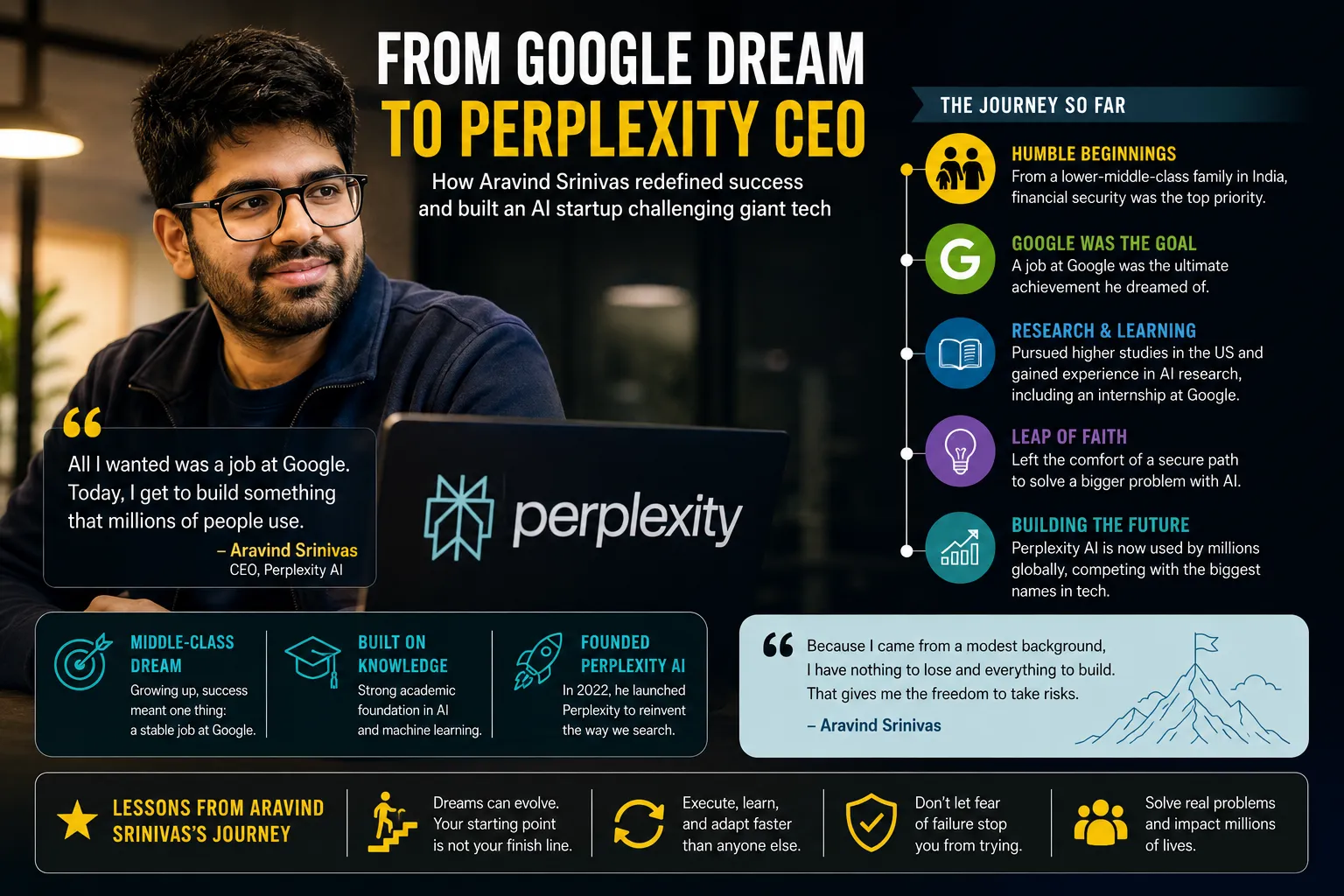
Perplexity AI CEO Aravind Srinivas recently reflected on how this mindset shaped his early ambitions. Growing up in a financially lower-middle-class family, he believed that getting a job at Google was the ultimate goal. Entrepreneurship, leading a global technology company, or competing with some of the world’s largest tech firms was never part of the original plan.
Today, however, Srinivas leads Perplexity AI, one of the fastest-growing artificial intelligence startups in the world. His journey illustrates how changing technology, evolving opportunities, and a willingness to embrace risk can completely redefine success.
A Simple Dream Rooted in Middle-Class Values
Speaking about his childhood, Aravind Srinivas explained that his family’s expectations were modest compared to where his career eventually took him.
He recalled that financial security mattered most while growing up. For his family, particularly his mother, simply getting a stable job represented success. Becoming an engineer at Google was viewed as the highest professional achievement a young software engineer could hope for.
Looking back, Srinivas acknowledged that his current achievements have gone far beyond anything he or his family imagined during those early years.
The Academic Foundation Behind His Success
Before becoming an entrepreneur, Srinivas built a strong academic background in computer science and artificial intelligence.
Originally from India, he pursued engineering before moving to the United States for higher education. His research work focused on machine learning and artificial intelligence, disciplines that would later become central to his entrepreneurial journey.
He also gained valuable industry exposure through research internships, including experience at Google, where he worked on cutting-edge AI technologies.
These experiences provided him with technical expertise while also exposing him to the rapidly evolving landscape of artificial intelligence.
From Research to Entrepreneurship
Transitioning from academic research to entrepreneurship was far from straightforward.
Researchers are often trained to perfect ideas before releasing them, but startups operate under very different conditions.
Srinivas has explained that one of the biggest lessons he learned while building Perplexity was abandoning the tendency to over-plan. Instead of waiting until every feature was perfect, he embraced rapid experimentation and continuous improvement based on user feedback.
According to him, execution often teaches entrepreneurs more than endless planning ever can.
Building Perplexity AI
Founded in 2022, Perplexity AI set out to rethink how people search for information online.
Rather than presenting users with long lists of web links, the platform focuses on delivering direct, conversational answers supported by cited sources.
The approach combines large language models with real-time web search to create an AI-powered answer engine that differs from traditional search engines.
Within a relatively short period, Perplexity attracted millions of users, significant venture capital investment, and growing attention across the global technology industry.
Its rapid growth has positioned the company among the most closely watched AI startups.
Competing in the Age of Artificial Intelligence
The rise of generative AI has transformed competition across the technology industry.
Companies are racing to build more capable AI assistants, search platforms, productivity tools, and enterprise solutions.
Perplexity operates in a highly competitive environment that includes some of the world’s largest technology companies.
Despite this challenge, Srinivas has consistently expressed confidence that innovation, product quality, and user experience provide opportunities for smaller companies to compete effectively.
Rather than focusing solely on size, he believes startups can succeed by solving problems differently.
A Different Definition of Success
One of the most striking aspects of Srinivas’s recent reflections is how dramatically his definition of success has changed.
Earlier in life, success meant securing employment at a prestigious company.
Today, it involves building technology, creating products used by millions of people, hiring talented teams, and competing globally.
He has remarked that because he came from modest circumstances, he feels he has already exceeded every expectation his family once had.
This perspective, he says, allows him to approach entrepreneurship without being consumed by fear of failure.
Why Fear Should Not Control Career Decisions
Srinivas frequently speaks about the importance of taking calculated risks.
He argues that fear of failure often prevents talented individuals from pursuing ambitious goals.
Because he believes his life has already surpassed what he once imagined possible, he prefers focusing on opportunities rather than worrying about potential setbacks.
This mindset has become one of the defining principles behind his entrepreneurial journey.
Instead of viewing uncertainty as a threat, he treats it as part of innovation.
Lessons for Young Professionals
Srinivas’s journey offers several important lessons for students and young professionals.
First, career ambitions can evolve over time. The goal that seems ideal during college may eventually become only one step in a much larger journey.
Second, technical expertise remains valuable, but continuous learning is equally important in fast-changing industries like artificial intelligence.
Third, entrepreneurship increasingly represents a realistic career path for talented engineers, researchers, and product builders who are willing to solve meaningful problems.
His story demonstrates that success is rarely linear.
India’s Growing Startup Ecosystem
The rise of founders like Srinivas reflects broader changes in India’s innovation ecosystem.
Over the past decade, India has produced thousands of technology startups across sectors including artificial intelligence, fintech, health technology, education, logistics, and software services.
Improved access to venture capital, global markets, cloud computing, and digital infrastructure has enabled entrepreneurs to build companies with international reach.
Young professionals who once viewed multinational corporations as their only career destination now increasingly consider launching startups of their own.
This cultural shift is gradually expanding the definition of professional success.
Artificial Intelligence Is Creating New Opportunities
Artificial intelligence has become one of the fastest-growing technology sectors worldwide.
Advances in machine learning, natural language processing, computer vision, robotics, and generative AI are creating entirely new business opportunities.
Companies developing AI-powered products now compete across education, healthcare, finance, enterprise software, customer support, scientific research, and creative industries.
Leaders such as Srinivas represent a new generation of entrepreneurs building businesses around these technological transformations.
The pace of innovation continues to reshape both industries and careers.
The Value of Adaptability
Perhaps the most important message from Srinivas’s journey is the importance of adaptability.
Career success today depends less on following predetermined paths and more on responding to changing opportunities.
Technology evolves rapidly.
Industries transform.
New business models emerge.
Professionals who remain curious, continue learning, and adapt to changing environments are often better positioned to succeed over the long term.
Srinivas’s transition from aspiring Google employee to founder and CEO illustrates how dramatically careers can evolve when individuals remain open to new possibilities.
Redefining the Middle-Class Dream
For decades, India’s middle-class aspirations centred around education, stable employment, and financial security.
Those values remain important.
However, the country’s growing startup ecosystem has added another dimension to professional ambition.
Many young engineers now aspire not only to work for leading technology companies but also to build them.
Entrepreneurship is increasingly viewed as a credible alternative rather than an uncertain gamble.
Stories like Srinivas’s demonstrate that today’s generation can combine technical excellence with innovation and global ambition.
Conclusion
Aravind Srinivas’s journey from a lower-middle-class upbringing in India to leading one of the world’s fastest-growing artificial intelligence companies reflects the changing nature of ambition in the modern technology industry. What once seemed like the ultimate career goal—a stable engineering position at Google—eventually became the starting point for a much larger vision. By embracing risk, continuous learning, and innovation, he transformed himself from an aspiring employee into the founder and CEO of a company challenging established approaches to online search.
His story resonates far beyond artificial intelligence. It highlights how education, determination, and adaptability can redefine traditional ideas of success. As India’s startup ecosystem continues to mature and AI reshapes industries across the globe, journeys like Srinivas’s inspire a new generation of entrepreneurs to think beyond conventional career paths. Rather than simply pursuing opportunities created by others, many are now choosing to create opportunities of their own.
islamicduahub islamicduahub islamicduahub islamicduahub islamicduahub islamicduahub islamicduahub islamicduahub islamicduahub islamicduahub islamicduahub islamicduahub islamicduahub islamicduahub islamicduahub islamicduahub islamicduahub islamicduahub islamicduahub islamicduahub islamicduahub islamicduahub islamicduahub islamicduahub islamicduahub islamicduahub islamicduahub islamicduahub islamicduahub islamicduahub islamicduahub islamicduahub islamicduahub islamicduahub islamicduahub islamicduahub islamicduahub islamicduahub islamicduahub islamicduahub islamicduahub islamicduahub islamicduahub islamicduahub islamicduahub islamicduahub islamicduahub islamicduahub islamicduahub islamicduahub islamicduahub islamicduahub islamicduahub islamicduahub islamicduahub islamicduahub islamicduahub islamicduahub islamicduahub islamicduahub islamicduahub islamicduahub islamicduahub islamicduahub islamicduahub islamicduahub islamicduahub islamicduahub islamicduahub islamicduahub islamicduahub islamicduahub islamicduahub islamicduahub islamicduahub islamicduahub islamicduahub islamicduahub islamicduahub islamicduahub islamicduahub islamicduahub islamicduahub islamicduahub islamicduahub islamicduahub islamicduahub islamicduahub islamicduahub islamicduahub islamicduahub islamicduahub islamicduahub islamicduahub islamicduahub islamicduahub islamicduahub islamicduahub islamicduahub islamicduahub islamicduahub islamicduahub islamicduahub islamicduahub islamicduahub islamicduahub islamicduahub islamicduahub islamicduahub islamicduahub islamicduahub islamicduahub islamicduahub islamicduahub islamicduahub islamicduahub islamicduahub islamicduahub islamicduahub islamicduahub islamicduahub islamicduahub islamicduahub islamicduahub islamicduahub islamicduahub islamicduahub islamicduahub islamicduahub islamicduahub islamicduahub islamicduahub islamicduahub islamicduahub islamicduahub islamicduahub islamicduahub islamicduahub islamicduahub islamicduahub islamicduahub islamicduahub islamicduahub islamicduahub islamicduahub islamicduahub islamicduahub islamicduahub islamicduahub islamicduahub islamicduahub islamicduahub islamicduahub islamicduahub islamicduahub islamicduahub islamicduahub islamicduahub islamicduahub islamicduahub islamicduahub islamicduahub islamicduahub islamicduahub islamicduahub islamicduahub islamicduahub