The global race to build the most advanced artificial intelligence systems has intensified like never before. In the latest development, OpenAI CEO Sam Altman openly acknowledged that Google currently holds an edge in the AI race with the launch of its new Gemini 3 model. While this might appear surprising to many, especially given OpenAI’s reputation for pushing boundaries with ChatGPT and its GPT models, Altman made it clear that Google’s lead is only temporary. According to him, OpenAI is moving rapidly toward the next breakthrough—one that could change AI development forever.
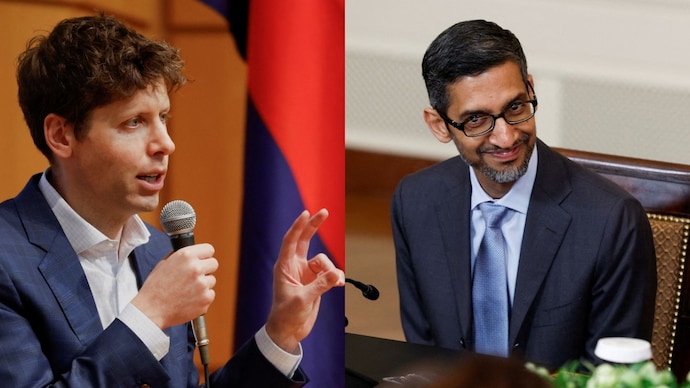
This statement has sparked major interest across the tech world. It is rare for CEOs of competing companies to make candid admissions about their rival’s strengths. Even rarer is the confidence with which Altman assured the world that OpenAI is preparing to surpass Google once again. So, what does this temporary lead mean, and how could the next phase of the AI race reshape the future?
Google’s Gemini 3: A Strong Temporary Lead
Google’s newly launched Gemini 3 has been described as the company’s most powerful AI model yet. Its ability to process multimodal inputs—text, images, audio, code, and video—has raised the bar. Early reviewers say Gemini 3 shows greater depth in reasoning, better accuracy, and improved efficiency compared to its predecessors.
Sam Altman openly acknowledged that Gemini 3 edges ahead of OpenAI’s current offerings in certain benchmarks. For Google, this is a much-needed boost in credibility after facing criticism in recent years for lagging behind in the generative AI space.
However, Altman’s tone was anything but worried. Instead of seeing this as a setback, he framed it as a natural part of the technological cycle—one where leaders change places frequently as innovation accelerates.
flourandpaper.com | forbesbusinessinsider.com | Higherseducation.com
targeted-medicine.com | publishbookmark.com
Why Sam Altman Called It “Temporary”
Despite praising Gemini 3, Altman emphasized that OpenAI is already working on far more advanced systems. His reference to “superintelligence” suggests OpenAI is not just focused on incremental improvements. The company is planning a dramatic leap forward, possibly with GPT-5 or even an entirely new family of models designed for more autonomous and human-like reasoning capabilities.
Altman’s confidence comes from three key areas:
-
OpenAI’s speed of development
The company has demonstrated an ability to iterate quickly, releasing new updates and models at an impressive pace. -
A strong research culture
OpenAI continues to prioritize fundamental research alongside product development, helping it stay at the forefront of innovation. -
A massive global ecosystem
Millions of developers, companies, and researchers rely on OpenAI tools, creating valuable real-world data and feedback that accelerates improvement.
Because of these factors, Altman strongly believes that OpenAI is on the verge of regaining its lead.
Superintelligence: The Next Giant Leap
One of the most striking elements of Altman’s statement was his reference to the future of AI—specifically, superintelligence. This term refers to AI systems that surpass human intelligence across nearly all domains, including creativity, reasoning, decision-making, and problem-solving.
OpenAI has repeatedly acknowledged that its long-term goal is to develop safe superintelligent systems.
If the organization is actively working on such technologies, it would naturally explain Altman’s confidence, even in the face of Google’s temporary dominance.
Superintelligence, if achieved, would not simply be another upgrade. It would transform industries, economies, and society. The AI race would shift from producing “smart assistants” to developing systems capable of independent innovation.
The Competitive Landscape: OpenAI vs. Google
OpenAI and Google have long been the two major players in the generative AI field. While OpenAI took an early lead with ChatGPT, Google’s recent momentum through Gemini shows it is fully committed to reclaiming its position.
The competition can be broken down into several areas:
1. Research and Development
Google has unmatched data resources and infrastructure. OpenAI has agility and bold experimentation. Each strength complements the other.
2. Product Ecosystems
Google integrates AI into Search, Gmail, YouTube, Android, and its entire home of products.
OpenAI has become the favorite tool of startups, innovators, and businesses.
3. Public Trust and Popularity
ChatGPT remains the most widely known AI model in the world. Google is now catching up as Gemini expands its reach.
This rivalry is pushing both companies to innovate faster—ultimately benefiting users worldwide.
Why This Race Matters
While competition between big tech companies is nothing new, the race to build the most advanced AI system is different. These systems do not merely shape markets—they shape countries, societies, and the future of human capability.
Some reasons this race is critical include:
-
AI will determine global leadership in technology
-
Billions of dollars depend on AI innovation
-
National security is directly impacted by AI progress
-
Industries like medicine, finance, education, and transport will be transformed
-
AI ethics, governance, and safety standards depend on leading companies
When Sam Altman calls Google’s lead “temporary,” he is also hinting that OpenAI’s next breakthrough could alter some of these dynamics.
What’s Next From OpenAI?
Although Altman did not reveal specific details, multiple signals suggest:
-
GPT-5 or a more advanced model may be nearing completion
-
OpenAI is focusing heavily on reasoning, context memory, and autonomy
-
Multimodal capabilities will improve drastically
-
Safety, control, and reliability remain top priorities
If OpenAI truly delivers a system closer to artificial general intelligence (AGI), the global AI landscape will change instantly.
Conclusion: A Race With No Final Winner
The AI race between OpenAI and Google is not a battle with a single winner. Instead, it is an ongoing cycle of breakthroughs, where one company leads for a while before the other catches up. Sam Altman’s admission about Google being ahead—paired with his confidence about OpenAI’s comeback—reflects the healthy competition driving AI forward.
In the end, the real winner is the world. As both companies push beyond their limits, humanity gets closer to unlocking the full potential of artificial intelligence.