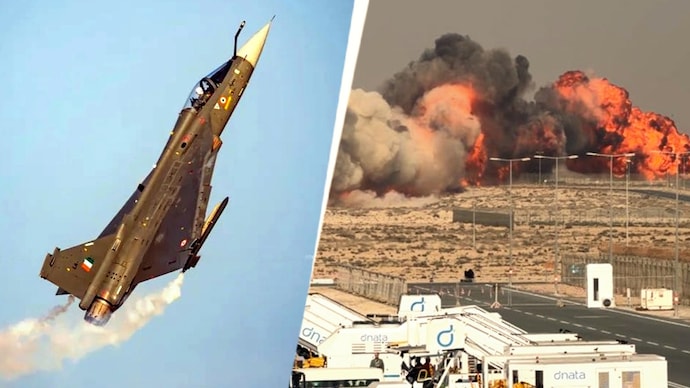
The recent Indian Air Force (IAF) Tejas fighter jet crash at the Dubai Airshow has shocked the aviation community and spectators worldwide. Preliminary investigations suggest that the IAF pilot may have been performing a barrel roll maneuver when the aircraft lost control, resulting in a fatal accident. Understanding the circumstances of this crash highlights the complexity and risk of high-performance aerobatic demonstrations.
The Incident at Dubai Airshow
The crash occurred during a live demonstration, one of the most anticipated segments of the Dubai Airshow. The HAL Tejas, India’s indigenous multirole fighter, was executing aerial maneuvers when it reportedly lost control mid-flight. Witnesses captured footage showing the aircraft spinning before impact, prompting immediate emergency response by airshow organizers.
The Tejas pilot, despite undergoing extensive training in aerobatics, did not survive the crash, marking a tragic loss for the IAF and the Indian defense community. Authorities are conducting a detailed investigation to determine the exact sequence of events that led to the accident.
texashomeandfloors.com | thedigitshub.com | thedigitalic.com
LogInomaSlot.info | BagLens.com
Understanding the Barrel Roll Maneuver
Experts indicate that the pilot was attempting a barrel roll, a maneuver where the aircraft completes a 360-degree rotation along its longitudinal axis while following a helical flight path. While it is considered a basic aerobatic maneuver for skilled pilots, performing it at high speed and in a crowded airshow environment adds significant risk.
Key points about the barrel roll maneuver:
-
Requires Precision: Pilots must carefully control speed, altitude, and angle of attack to avoid overstressing the aircraft.
-
High-Stress on Aircraft: Even modern jets like Tejas are subjected to significant G-forces and mechanical stress during such maneuvers.
-
Limited Margin for Error: Misjudgment in timing or angle can result in a loss of control.
While barrel rolls are often performed safely during airshows, a combination of pilot error, mechanical issues, or environmental factors can result in accidents.
About HAL Tejas Fighter Jet
The HAL Tejas is India’s light combat aircraft, developed by Hindustan Aeronautics Limited (HAL) and the Aeronautical Development Agency (ADA). Key features include:
-
Advanced fly-by-wire control systems
-
Lightweight and highly maneuverable frame
-
Multirole capabilities including air-to-air combat, ground attacks, and reconnaissance
Since its induction into the IAF, the Tejas has participated in training exercises, operational missions, and airshow demonstrations, proving itself as a symbol of India’s aerospace self-reliance.
Airshow Risks and Safety Protocols
Aerial demonstrations at international airshows are high-risk events. Pilots must execute precise maneuvers within tight schedules and near large crowds. Factors contributing to risk include:
-
High-Speed Aerobatics: Aircraft perform sharp turns, loops, and rolls at high speeds, leaving little margin for error.
-
Environmental Conditions: Wind, temperature, and visibility can influence aircraft performance.
-
Crowd Safety Concerns: Maneuvers must balance display quality with spectator safety.
While strict safety protocols are in place, accidents can occur despite the best preparations. The IAF and Dubai Airshow organizers are likely reviewing emergency procedures and maneuver planning following the incident.
Pilot Training and Expertise
Tejas pilots undergo rigorous training to perform aerobatics safely. Training focuses on:
-
High-G maneuver handling
-
Barrel rolls, loops, and other advanced aerobatics
-
Emergency ejection and response procedures
Despite this training, executing complex maneuvers in real-world airshow conditions involves split-second decisions and coordination, which occasionally can lead to fatal outcomes.
Immediate Response to the Crash
After the crash, emergency teams responded promptly:
-
Firefighting and rescue units secured the site
-
Spectators were evacuated from nearby areas
-
The Dubai Airshow authorities coordinated with the IAF for technical investigation
The incident temporarily halted the aerial demonstration schedule, and organizers expressed condolences to the pilot’s family and the Indian delegation.
Global Context of Airshow Accidents
Airshow crashes, while rare, have occurred historically across the globe. Even highly trained pilots flying modern fighter jets can face accidents due to:
-
Mechanical failure
-
Misjudgment during complex maneuvers
-
Environmental factors or unexpected turbulence
Such incidents highlight the inherent risks of aerial demonstrations and the bravery of military aviators who perform these displays.
Investigation and Next Steps
The IAF has announced a court of inquiry to determine the cause of the crash. Key areas under investigation include:
-
Aircraft maintenance and technical health prior to flight
-
Pilot actions and maneuver execution
-
Environmental and airshow-specific conditions
HAL and ADA teams are expected to assist in technical analysis, including reviewing flight data logs and onboard system performance. The goal is to prevent similar incidents in the future and enhance safety protocols for airshows.
Impact on the Indian Air Force and Tejas Program
While the accident is tragic, it is unlikely to derail the Tejas program, which remains a cornerstone of India’s indigenous fighter development. However, the incident may influence:
-
Airshow participation guidelines for Indian jets
-
Safety protocols and emergency preparedness
-
Additional pilot training focused on high-risk maneuvers
The IAF continues to emphasize operational readiness and pilot safety, even as it showcases Indian aerospace capabilities internationally.
Conclusion
The IAF Tejas jet crash at the Dubai Airshow serves as a reminder of the high-risk nature of aerobatic demonstrations. Preliminary reports suggest the pilot was performing a barrel roll maneuver, a complex aerobatic move that requires precision and skill. Despite rigorous training and advanced aircraft systems, accidents can occur due to the combination of human, mechanical, and environmental factors.
As investigations continue, the Indian Air Force and HAL will likely focus on enhancing safety measures, revising airshow protocols, and learning from this unfortunate incident. Meanwhile, the aviation community and global spectators mourn the loss of a skilled pilot, acknowledging the courage and expertise required to perform at the highest levels of military aviation.